Thursday, September 4, 2014

Léon: The Professional (1994) by Luc Besson

’Léon: The Professional’’ is an American-French thriller movie directed and written by the famous French director Luc Besson. The film was made in English originally and released in 1994. The film tells the story of a professional assassin (Leon) who saves a young girl (Mathilda) whose family gets killed during a police raid by the corrupt DEA agent Norman Stansfield (Gary Oldman).
The professional assassin Leon (played by Jean Reno) is living an isolated life in an apartment in New York’s Little Italy. He works for a Mafioso called Tony who operates from an Italian restaurant. Leon seems to be really good at his job and is occupied with almost nothing else other than his work. He just works out at home, takes care of a houseplant which he refers to as his ‘best friend’ and drinks milk.  One day, the father of the family next door raises suspicions from some corrupt DEA agents who have been paying him to stock cocaine in his apartment. When they find out some of the cocaine is missing they kill all the family members except the 12 year-old Mathilda (Natalie Portman) who had been out shopping. Leon gives shelter to Mathilda who wants him to teach him his hitman skills to take revenge for the death of his little brother. In exchange, Mathilda teaches Leon how to read, cleans his apartment and runs errands for him. In the end, Leon gets killed by Stansfield while trying to protect Mathilda from them, however manages to take Stansfield with him to the other side as well, and leaves his money to Mathilda who gave him ‘a taste of life’.

            Leon: The Professional, as many know, is a cult movie. I see this movie as a movie about the power of love (not sexual or romantic love necessarily) but there are many other themes as well, like the power of education or prejudices. I really enjoyed the cinematography and the 90s atmosphere in Little Italy. Other than that, I really liked the rich and realistic outcast characters, Leon and Mathilda, the story development came from them rather than relying on action. You can easily empathize with both. Furthermore, I think Jean Reno fitted the character Leon perfectly, and I believe all in his other movies his characters are similar to Leon in some way, Wasabi or Tais Toi are some examples. Although some might have found some scenes disturbing or some parts of the film uncomfortable, I liked the emotions that the film made me feel. 

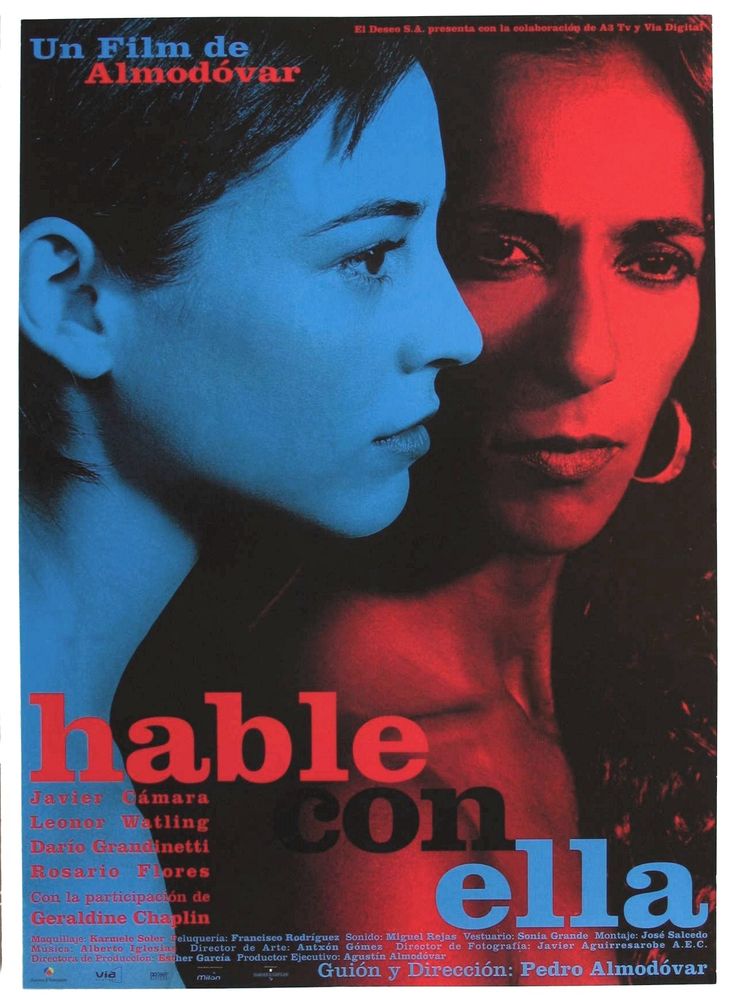
Talk to Her (Hable con Ella) by Pedro Almodovar

Talk to Her (Hable con Ella in Spanish) is a Spanish drama made in 2002 and directed by the celebrated director Pedro Almodóvar.  The film tells the story of two men, Benigno and Marco, which share an odd situation and build a strong friendship. The story is mainly told in flashbacks. Benigno Martin (played by Javier Cámara) is an anti-social man with an incredibly good heart who is working as a nurse at a hospital, and Marco Zuluaga (Darío Grandinetti) is a famous Argentinian journalist who is well-known for his travel guide books. Marco falls in love with a famous woman bull fighter, Lydia Gonzalez (Rosario Flores) who is known for her past relationship with another famous bullfighter. One day during a bullfight, Lydia gets injured badly and is admitted into a hospital. She enters in a state of coma indefinitely.  While spending time in the hospital, waiting and wandering around, Marco meets Benigno who tells his own story to him. Benigno is the personal nurse of another patient in coma, Alicia, who is a beautiful dance student. Although Benigno sees Alicia as alive and as his lover, we understand from his story that he had been obsessed with her for a while before she was in coma. Benigno, since he sees Alicia alive and believes she hears him in coma, constantly talks to Alicia, telling everything in his life to her. When he meets Marco, he advises him to talk to Lydia as well and that’s where the film gets its title from. After a while, when Marco is abroad writing another travel book, Benigno is imprisoned due to allegations that he raped and impregnated Alicia in the hospital. Benigno accused of being a sociopath rapist, commits suicide in the end and the movie ends in the theater where it started and where Marco meets Alicia by chance.
Talk to Her, in my opinion, is a film with many themes and a film that is open to different interpretations since some vital things about the plot are ambiguous, like if Benigno really raped Alicia. Some believe that Benigno really raped her, or some say it was Marco, but it is never revealed in the movie who really impregnated her. Despite all, I see this film as a film about friendship, love and obsession and I see Benigno as a man with weak social skills and a very good heart. Many symbols and metaphors are used in the movie about life, emotions and love, an example is the short silent film clip about the love between a man and a scientist woman. Ultimately, I agree with Roger Ebert who noted ‘’… and yet at the end, we are undeniably touched. No director since Fassbinder has been able to evoke such complex emotions with such problematic material.’’

Wednesday, September 3, 2014

La Dolce Vita by Federico Fellini

La Dolce Vita is a cult Italian movie released in 1960 and directed by the famous director, Federico Fellini. It basically follows the stories that unfold in a week in the life of famous gossip journalist in Rome, showing us the aristocratic life in Rome in the 60s. The main character, the paparazzi, is Marcello (played by Marcello Mastroianni) that has the same name with the actor who plays him. Marcello is a really handsome and a cool man that knows almost everyone in high society in Rome. The film shows us the ‘sweet life’ in Rome, as the title suggests, with all its colorfulness, the aristocracy, the cabarets, models, second-rate movie stars, homosexuals.. It shows this sweet night life and the characters in a neutral way, and does not judge them about their character. The film is formed of 7 sequences, or stories. Marcello usually acts as an observer and lets his fate determined randomly, always seduced by others to spend the night with them.
The other two main characters in the movie are Sylvia and Maddalena played by Anita Ekberg and Anouk Aimee respectively. Sylvia is a famous, seductive and a very beautiful Swedish-American actress which visits Rome. Fellini’s choice of giving this part to Anita Ekberg is significant since the character Sylvia is basically Anita Ekberg herself, the famous Swedish model, actress and a sex symbol back in her time. Many critics state that although the acting skills of Anita Ekberg are not exceptional, nobody could play her better than herself. Maddalena, on the other hand, is a beautiful and a very rich heiress who is bored of her life and is in the search of new adventures.
La Dolce Vita is a very famous film that is regarded as a masterpiece. It has been interpreted in many ways and is open to many different interpretations since it is deep and metaphorical in many aspects. I thought of it as Marcello’s learning about life and his journey to his inner self, as he spends time with many different types of people from the Roman society. The film is also satirical in my opinion, and criticizes the life of Roman aristocracy. In my opinion Marcello is in search for happiness and on his way observes the different choices of life paths with the help of different characters like Steiner (Alain Cuny) and is passive most of the time although he is the main character. He is in my opinion trying to find ‘his own’  sweet life while on the way being seduced by different life styles. In the movie, he lives a life which most people would envy, a life in which he has everything he wants and does not have to do much for it. He is basically free all the time; his job is to spend time among aristocracy and other members of high society. He has money, and there are always women around him. Yet he feels like he is wandering aimlessly and wasting his time.  He does not know what he wants exactly, does not know what to devote himself for and he is not sure about his passions. He doesn’t want to continue wandering aimlessly yet he doesn’t want to marry and settle down and continue his life in a cage neither.


Wednesday, May 14, 2014

In Bruges is a movie that I really like, and I liked making a three reasons video about it. Since I really like the movie, I didn't have a hard time deciding on the three reasons that make the movie valuable. The difficulties I had in the process of making the three reasons video were mostly technical difficulties regarding the type of the movie file. I lost a few hours in the process because of wrongly converting the movie file into the format that final cut pro requires. Apart from that, I also had diffculties shortening the video clips in general, since it's a bit hard to show the type of humour used in the movie through very short clips, and it is kind of hard to make a short video clip anyways. At first my three reasons video was over five minutes long, but then i managed to shorten it according to the requirements. Overall, I think I managed to create a successful three reasons video like the example ones we had watched on Youtube, and I am happy to promote In Bruges, letting people know why it's a great movie to watch.
https://www.youtube.com/watch?v=ateOVQ-3h-8&feature=youtu.be